













Sauna benefits: what the research shows, and how strong it is

The biggest data set comes from one Finnish study of middle-aged adults: people who used a sauna four to seven times a week had lower rates of fatal heart disease, stroke and dementia than once-a-week users. That's an association in one population, not proof the sauna caused it. Direct trials are small; the best one, with 47 adults, found a larger drop in blood pressure when a sauna followed exercise. Detox, fat loss and immune claims aren't supported.
The evidence at a glance
I rated each claim with the rule from how we research. Strong: several randomized trials, or a review of them, agree. Moderate: some randomized trials agree, but they're small or short. Limited: a few small or uncontrolled studies, or long-term observation of one group of people. None: no link found, or no human studies. Most sauna research is observational, so most rows land on limited, even when the numbers look big.
| Claim | Study | Who and how many | What it found | Evidence |
|---|---|---|---|---|
| Heart disease and death from any cause | Finnish cohort, 2015 | 2,315 men, about 20 years | Using a sauna 4–7 times a week was associated with fewer fatal heart events and deaths than once a week | Limited |
| Same, in women too | Same cohort, 2018 | 1,688 adults, 51% women, 15 years | Associated with fewer cardiovascular deaths at 4–7 times a week | Limited |
| Developing high blood pressure | Same cohort, 2017 | 1,621 men, about 25 years | Associated with lower risk at 4–7 times a week; at 2–3 times the link wasn't significant | Limited |
| Blood pressure over 8 weeks | Randomized trial, 2022 | 47 inactive adults with a heart risk factor | A 15-minute sauna after exercise lowered systolic pressure 8 mmHg more than exercise alone | Limited |
| Blood pressure right after a session | Meta-analysis, 16 studies; before-and-after study | 102 adults in the single study | Temporary drop: 137 to 130 mmHg systolic after 30 minutes; pooled studies agree | Moderate |
| Stroke | Finnish cohort, 2018 | 1,628 adults, 15 years | Associated with fewer strokes at 4–7 times a week | Limited |
| Dementia | Finnish cohort, 2017 | 2,315 men | Associated with fewer dementia diagnoses at 4–7 times a week | Limited |
| Lung illness | Finnish cohort, 2017 | 1,935 men, about 26 years | Associated with fewer hospital-diagnosed respiratory illnesses, including pneumonia | Limited |
| Colds | Controlled study, 1990 | 50 adults, 6 months | Fewer colds in the sauna group; length and severity no different | Limited |
| Cancer | Finnish cohort, 2019 | 2,173 men, about 24 years | No link either way | None |
| Cholesterol | Infrared review, 2009; review of 7 trials, 2025 | Small trials | Infrared: evidence against. Hot springs and sauna: lower lipids only under age 60 | Limited |
| "Detox" through sweat | Systematic review, 2012 | Studies of sweat | Toxic elements are found in sweat; no study shows a health benefit from sweating them out | None |
| Weight loss | Small study, 2003 | 12 adults | Weight dropped 1.4–1.8% over three sessions, all of it water | None |
What the Finnish studies found, and their limits
Almost every headline about saunas and long life traces back to one study: the Kuopio Ischemic Heart Disease Risk Factor Study in eastern Finland. Its numbers are striking. In the 2015 paper, men who used a sauna four to seven times a week had a sudden cardiac death rate about a third of the once-a-week group's (hazard ratio 0.37). But only 201 of the 2,315 men were in that group, and most went two or three times a week.
The limits are the same for every row above that cites this cohort: one population in eastern Finland, traditional Finnish saunas at 176–212°F, sauna habits reported by the participants once at the start, and mostly one research group. People who are already healthy may simply be more likely to sit in a hot sauna several times a week, and observation can't rule that out. That's why I write "associated with," never "reduces." The authors' own 2018 review describes possible mechanisms, such as stiffer or more relaxed arteries, but it is a review by the same group, not a new trial.
None of this was measured in infrared cabins or in Americans.
What trials measured directly
Randomized trials are where cause and effect can show up, and there are few of them. A 2018 systematic review counted 40 clinical studies of regular dry sauna use with 3,855 participants. Only 13 were randomized, and most had fewer than 40 people. Most reported some benefit; the one harm was a reversible drop in sperm production in a study of 10 men.
The trial I'd point to first is a 2022 study of 47 inactive adults, average age 49, each with at least one heart risk factor. One group exercised, one exercised and then sat in a sauna for 15 minutes, and one did neither, for eight weeks. Adding the sauna lowered systolic blood pressure by 8.0 mmHg more than exercise alone and raised fitness a little more. With about 16 people per group, the range around that 8 mmHg is wide (1.4 to 14.6).
The short-term effect is better established. Blood pressure drops for a while after a session: from 137 to 130 mmHg systolic in 102 adults after 30 minutes at 163°F, and by about 5.5 mmHg across 16 pooled studies. That's a temporary change, not a lasting one.
The cold study is older and smaller: in a 1990 trial of 50 people, the sauna group reported about half as many colds in the last three months of a six-month period. Nobody has repeated it at scale.
Traditional vs infrared: is the evidence the same?
No. The Finnish data is about traditional saunas heated to 176–212°F. Infrared research is mostly a Japanese clinical routine called Waon therapy: 15 minutes at 140°F, then 30 minutes resting under a blanket, given to hospital patients with heart failure.
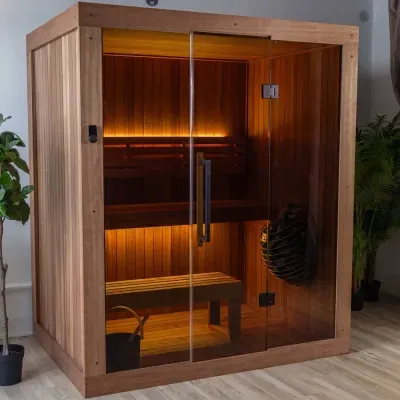
If you want the kind of heat the Finnish cohort used, check the maximum temperature before you buy. These traditional saunas list 176°F or more; compare the rest on dry saunas and outdoor saunas:


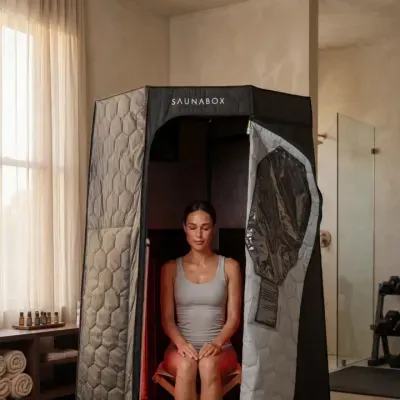
For the Waon routine, these infrared cabins list at least 140°F (more on infrared saunas):
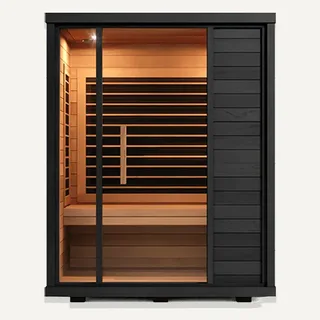
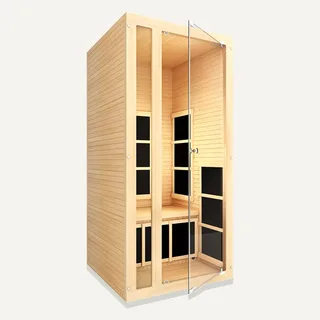
Reaching a temperature isn't the same as getting a result. These lists match heat to the studies; they don't promise what the studies found.
After a workout
Studies of sauna after exercise are small and point in different directions. In one randomized crossover trial of 20 swimmers and triathletes, a sauna after hard training was followed by slower swim times the next morning.
What saunas aren't shown to do
Detox. A 2012 systematic review found toxic elements in sweat and suggested sweating deserved "consideration." It didn't show that sweating them out improves health. A 2023 pilot study of 10 women found pesticide breakdown products in sweat after infrared sessions, but its authors wrote that "definitive sweat/urine correlations were not demonstrated." Cleveland Clinic's infrared sauna page calls the toxin research "still in its infancy."
Weight loss. The scale moves because you lose water. In a small 2003 study, three 20-minute sessions at 158°F took off 1.8% of body weight in men and 1.4% in women, and an hour of drinking didn't bring it back.
Immunity. In December 2020 the FTC sent warning letters to two sauna sellers, Celebration Saunas and Enlighten Sauna, over claims that infrared saunas could prevent or treat COVID-19. There's no trial showing a sauna strengthens the immune system.
Cholesterol. A 2009 review of infrared sauna research found evidence against cholesterol claims. A 2025 review of seven trials of hot springs and sauna saw lower blood fats only in adults under 60, and rated its own recommendation weak.
Cancer. The Finnish cohort found no link between sauna use and cancer, in either direction.
How often and how long the studies used
Most men in the Finnish cohort went two or three times a week, and sessions longer than 19 minutes were associated with fewer sudden cardiac deaths than sessions under 11 minutes. The 2022 trial used 15 minutes after exercise. Nobody has worked out an ideal dose: the 2018 systematic review says further study is needed "to determine the optimal frequency and duration."
Who should skip it
A review in the American Journal of Medicine lists unstable angina, a recent heart attack and severe aortic stenosis as reasons not to use a sauna, and warns that alcohol in the sauna raises the risk of low blood pressure, irregular heartbeat and sudden death. Blood pressure medicines can make you dizzy when you stand up afterward (2006 review). In pregnancy, MotherToBaby advises that "hot tub or sauna use during pregnancy should be limited."
This page summarizes research; it isn't medical advice (see our medical disclaimer).
Questions people ask
Do saunas really sweat out toxins?
Sweat does contain small amounts of metals and other compounds, but no study has shown that sweating them out in a sauna improves health. Cleveland Clinic calls that research "still in its infancy."
Is sauna good for losing belly fat?
No study shows it. The weight you lose in a sauna is water: about 1.4–1.8% of body weight over three sessions in one small study, and it returns when you drink. A 2009 review of infrared sauna research rated the evidence on obesity as weak, from a single study.
What is the downside of a sauna?
Dizziness when you stand up, dehydration and burns are the common problems. Alcohol is the big one: about half of sauna deaths in Finland from 1990 to 2002 involved it (forensic study, 2008). People with unstable heart disease, and pregnant women, should check with a doctor first.
How many times a week should you sauna?
There's no proven number. In the Finnish cohort most men went two or three times a week, and four to seven times was associated with the lowest rates of heart disease and death, but that's observation, not a prescription.
What should you not do after a sauna?
Don't drink alcohol, don't stand up fast if you feel light-headed, and replace the water you lost. A Brown University Health cardiologist advises people with heart disease not to plunge into ice water afterward (Brown Health).