
Can a red light bulb do red light therapy? What the measurements show

Most red bulbs in a hardware store are night lights or heat lamps, not therapy devices. In the one spectrometer comparison I found, a 250-watt incandescent therapy lamp gave 2 mW/cm² of red light at 12 inches, and an LED panel at the same distance gave 30. LED therapy bulbs with 660 and 850 nm chips start at $39.99, but I found no independent measurement of any of them.
Three kinds of "red light bulb"
A search for "red light bulb" mixes three products that share a screw base, a color and little else. The label tells them apart.
| Sleep bulb | Heat lamp | LED therapy bulb | |
|---|---|---|---|
| Sold for | Evening light without blue | Warmth | Red light therapy |
| The box lists | Lumens, kelvins, "blue light free" | 250 W, R40 or BR40, red glass | 660 and 850 nm, mW/cm² at a distance |
| Example | BlockBlueLight Twilight: 5 W, peak 630 nm (brand) | Feit 250R40/R, Philips 250BR40 | Hooga HG24: 24 W (12 dual-chip LEDs, 2 W each) |
Only the third is sold for therapy. A sleep bulb has one red band, a few watts and no near infrared. Feit and Philips sell their heat lamps as heaters, nothing more. In between sits the incandescent "near infrared" lamp, like the RubyLux NIR-A or the SaunaSpace Glow: the same 250-watt filament, sold for its infrared.
Seven bulbs and lamps compared
| Model | Type | Price | Light | Stated output | FDA | Warranty / returns |
|---|---|---|---|---|---|---|
| Hooga HG24 Handheld (24 W) | LED, E26 base | $45 | 660 and 850 nm | 80 mW/cm² at 6 in; 126 mW/cm² at 3 in (brand) | No record found | 3 years; 60-day trial |
| Hooga HG24 4-in-1 | LED, E26 base | $39.99 | 415, 590, 660 and 850 nm | Not published | No record found | 60 days from delivery; return shipping is deducted from the refund |
| ABI LED Light Therapy Bulb 660nm + 850nm Combo (54W Class) | LED, E26 base | $65.59 | 660 and 850 nm | 53.8 mW/cm² at 6 in, 27.8 mW/cm² at 12 in (seller figures, meter not stated) | No record found | 3-year manufacturer warranty; 30 days (Newegg seller) |
| RubyLux NIR-A Near Infrared Bulb 250W | Incandescent, 250 W | $43.14 | Broad, peak 850 nm (brand) | Not published | No record found | Not published |
| SaunaSpace Glow Infrared Therapy Light | Incandescent, 250 W | $695 | 550–3000+ nm (brand) | "2–4x" a typical heat lamp in 600–1000 nm (brand) | No record found | Not published |
| Feit Electric 250 Watt BR40 Red Reflector Heat Lamp 250R40/R | Heat lamp, 250 W | $47.52 | Not stated | Not published | Not a medical device | Not published |
| Philips 250W BR40 Red Safety Coated Heat Lamp | Heat lamp, 250 W | $18.99 | Not stated | Not published | Not a medical device | Not published |
None of the seven has an FDA record I could find. Check four prices at the store: the Glow's is from an owner's notes page (saunaspace.com didn't load for me), and the Feit, Philips and RubyLux prices are from search listings.
Bulb vs. panel: what a spectrometer showed
Alex Fergus of lighttherapyinsiders.com is the only reviewer I found who put a bulb and a panel under the same spectrometer:
| Light source | Distance | Red, 620–680 nm | 800–870 nm | 800–1,050 nm | Source |
|---|---|---|---|---|---|
| SaunaSpace Photon, one 250 W incandescent bulb | 12 in | 2 | 6 | 21 | Jan 4, 2025 |
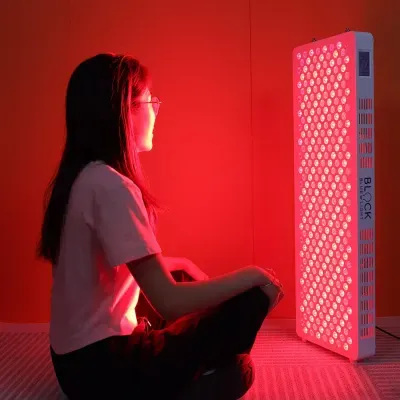
| Block Blue Light Mega LED panel | 12 in | 30 | 39 | 41 | same review |
| Hooga red night light | Not stated | 2.3 in total, peak at 634 nm | Sep 4, 2025 | ||
| Wood fireplace, glass door closed / open | 6–8 in | 0.12 / just under 1, in total | Mar 29, 2025 | ||
The red band shows the widest gap: 2 against 30. Dose is power × time (J/cm² = mW/cm² × seconds ÷ 1,000), so 10 J/cm² of red takes about 83 minutes from the bulb and 5.6 from the panel. Fergus uses 10 J/cm² as "a therapeutic dose" and gets "around 83 minutes" for the night light. In the near infrared the bulb does better: 21 against 41.
The brand's number is far higher. SaunaSpace states 135 mW/cm² at 12 inches for the Photon, and Fergus explains why: "This figure likely includes energy from all wavelengths—near-infrared, mid-infrared, and far-infrared—whereas my spectrometer only measures up to 1050nm." The two figures count different light, so neither is wrong; they just can't be compared.
LED claims have a different problem: the meter. Nick Urban of outliyr.com writes that a solar power meter "catches ambient light, reflections, even infrared heat, and adds it all into one inflated number," and that brand figures have run "40 to 70% higher than spectroradiometer-measured values" (outliyr.com, updated June 21, 2026). Hooga's own panel fits: the Hooga HG300 measured 55 mW/cm² for Fergus, 75% of the 73 Hooga states. More in red light panel irradiance.
Limits: one reviewer, one lamp, one panel. The Glow also uses one 250-watt bulb, but it's a different product, and nobody has measured it.
LED therapy bulbs (E26)
These three screw into a regular E26 socket and carry 660 and 850 nm chips. None has an independent measurement, so every output figure below comes from the seller.
Hooga HG24 Handheld (24 W), $45. 12 dual-chip LEDs, 2 W each. Hooga states 80 mW/cm² at 6 in; 126 mW/cm² at 3 in. 3 years warranty, 60-day trial. It also appears among wands. Hooga's panel figure ran ahead of the measurement, so treat this one as a ceiling.
Hooga HG24 4-in-1, $39.99. Four colors: 415, 590, 660 and 850 nm. The 415 nm is blue light and 590 is amber; Hooga publishes no output figure or LED count. For red and near infrared alone, the plain HG24 at least gives a number.
ABI 660 + 850 nm Combo, $65.59 from a Newegg seller. 12 (6 × 660 nm + 6 × 850 nm), 14 W draw (24 W rated). The seller states 53.8 mW/cm² at 6 in, 27.8 mW/cm² at 12 in without naming a meter. Even its own figure drops 48% from 6 to 12 inches, which is why a bulb has to sit close. 3-year manufacturer warranty; 30 days (Newegg seller).
On paper the HG24's 80 mW/cm² at 6 inches beats ABI's 53.8. Both come from unnamed meters, so that tells you little.
Incandescent and heat lamps
A 250-watt filament gives off a broad spread of light, and in Fergus's readings far more of it fell in the near infrared than in the red.
The RubyLux NIR-A ($43.14) is sold as a near infrared bulb with a peak at 850 nm, per the brand; the listing asks for a heat-rated socket for 250 W or more. The SaunaSpace Glow ($695) puts one 250 W bulb behind a steel guard on a tabletop stand. SaunaSpace says it covers 550–3000+ nm and gives "2–4x the irradiance in the photobiomodulation range (600–1000nm) compared to typical incandescent heat lamps" (SaunaSpace help center), with no mW/cm² figure.
The Feit 250R40/R ($47.52 for 6, about $7.92 a bulb) and the Philips 250BR40 Red ($18.99) are ordinary heat lamps. Before one goes near your skin, read the warning Sylvania printed for its soft-glass 250-watt R40/BR40 heat lamps: "This lamp should never be placed closer than 18 inches to any person or surface," and "Do NOT use this lamp in wet or moist environments, including sauna, shower, bathing, bathroom." It points to "heat-resistant-glass" lamps for those places and asks for "sockets designed for 250-watt use" (Osram Sylvania FAQ, 2000). Check your box for "hard glass" and follow that maker's distance. Note that 18 inches is farther than the 12 at which Fergus got 2 mW/cm² of red.
Is any red bulb good for sleep?
That's a question about evening light, not therapy. Sleep bulbs are sold on what they leave out: BlockBlueLight says its Twilight blocks "100% between 380-580nm," which covers blue and green. Fergus uses the Hooga night light in his son's room for "light at night that won't mess with sleep." I haven't found a study of these bulbs and sleep, so those claims stay with the brands.
Is there a red light bulb that doesn't flicker?
Brands answer this one, not measurements. SaunaSpace calls its incandescent light "naturally flicker-free" and says LEDs "tend to flicker" (SaunaSpace). BlockBlueLight says the Twilight has "zero flicker." With LEDs it depends on the driver, and none of the three LED bulbs above publishes a flicker figure. I found no independent flicker test of any of them.
When a bulb makes sense, and when a panel does
- To try red light on one spot for little money: the Hooga HG24 Handheld (24 W) at $45, held close, knowing its output is unmeasured (Hooga review).
- For a 10 J/cm² dose in minutes: a panel with an independent measurement. The cheapest three with a store link: Hooga HG300 ($199, 55 mW/cm² at 6 in, about 3 min), Mito Red Light MitoPRO 1500+ ($1,169, 76.5 mW/cm² at 6 in, about 2.2 min) and PlatinumLED BIOMAX 900 ($1,299, 90 mW/cm² at 6 in, about 1.9 min). All of them: red light therapy panels.
- For heat with near infrared: red light saunas, not a heat lamp in the bathroom.
Distance, session length and eye protection: how to use red light therapy and is red light therapy safe. What trials found, and at what doses: red light therapy benefits. This page isn't medical advice (medical disclaimer).
Questions people ask
Can I just use a red light bulb for red light therapy?
Not a sleep bulb or a heat lamp; neither is sold for it. LED therapy bulbs are, but none has been independently measured. In the one bulb-vs-panel test I found, a 250 W lamp gave 2 mW/cm² of red at 12 inches against 30 for a panel (details).
What does a red light bulb do for you?
A sleep bulb gives dim light without blue, a 250 W heat lamp gives warmth, and an LED therapy bulb gives light at 660 and 850 nm. How to tell them apart.
Is any red light bulb good for sleep?
Bulbs sold for sleep, like BlockBlueLight's Twilight, leave out blue and green light. I found no study of these bulbs and sleep, so that claim is the brands'.
Is there a red light bulb that doesn't flicker?
Brands say so: SaunaSpace for its Glow, BlockBlueLight for the Twilight. I found no independent flicker test of any bulb here.