




Can red light therapy cause cancer? What studies show about safety, eyes and side effects

No study has shown that low-power red or near-infrared light causes cancer in people: a 2023 systematic review found no clinical-trial data linking it to new or returning cancer, and cancer-care guidelines even recommend laser light inside the mouth during some cancer treatments. In mice, very high laser doses made melanoma grow faster, so makers ask people with cancer to see a doctor first and not to aim the light at a tumor. The documented problems are with the eyes. This page summarizes studies and manuals; it isn't advice for your case (see the medical disclaimer).
Can red light therapy cause cancer?
In people, there's no sign of it. Lab and mouse results are mixed, and the worrying one came at doses far above a home device.
| Study | Type | What it found |
|---|---|---|
| Glass 2023 | Systematic review | "No relevant clinical trial data linking PBM with… a new or recurrent malignancy." Single author, evidence level 4. |
| Bensadoun 2020 | Systematic review, 67 studies | Lab results conflict; animal and clinical studies with follow-up found it "safe with regards to tumor growth." Clinical lasers, not home LEDs. |
| MASCC/ISOO 2020 | Clinical guideline | Recommends low-level laser inside the mouth against oral mucositis (mouth sores) in some adults having stem-cell transplants or head-and-neck radiotherapy. |
| Sperandio 2013 | Lab, oral cancer cells | 660 and 780 nm laser "could aggravate oral cancer cellular behavior." |
| Frigo 2009 | Mice with melanoma, n=21 | 150 J/cm²: no different from untreated mice. 1,050 J/cm²: larger tumors. |
| Frigo 2018 | Mice with melanoma | 150 J/cm² no different; 450 and 1,050 J/cm² grew tumors faster as the dose rose. |
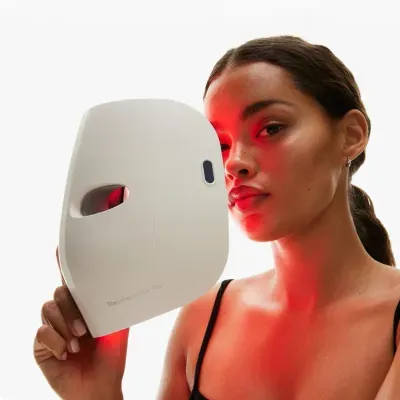
Those mouse doses mean little until you set them next to a mask. The Omnilux Contour Face (K191629) puts out about 30 mW/cm² for 10 min, and the CurrentBody LED Red Light Therapy Face Mask: Series 2 (K250966) lists the same. Power times time is about 18 J/cm² per session (my calculation). The dose that sped up tumors in mice was about 58 times that, and even the harmless 150 J/cm² was about 8 mask sessions. That's scale, not proof: mice aren't people, they got a laser at 2.5 W/cm², and a panel held close gives more per minute than a mask.
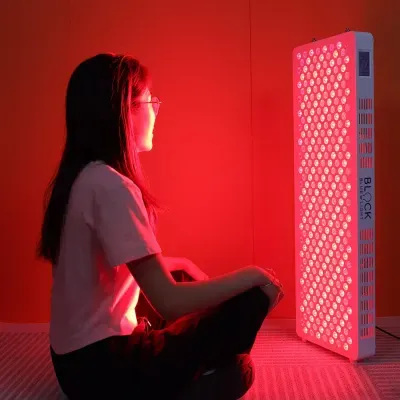
The American Academy of Dermatology says "research hasn't found that red light can cause any type of cancer" (AAD, Sept 2024). Makers are more careful. Mito's manual: "There is a theoretical risk that red light therapy may increase cell proliferation in malignant cancers" (MitoPRO manual, Jan 2025). Joovv: "Users with cancer or history of cancer should consult their physician prior to use" (Joovv support). CurrentBody's first-generation mask manual says the same and adds "suspicious or cancerous lesions" (manual PDF).
Devices with an FDA 510(k) are listed on FDA-cleared red light therapy devices.
Eyes: the real risk
LEDs are rated for eye safety under the standard IEC 62471, which sorts light sources into four groups from Exempt to High risk (ams OSRAM summary). Joovv says its Gen 3.0 panels are Risk Group 1, "low risk," and that the included eyewear "should be used when NIR is active" (Joovv support). The 510(k) summaries for the Omnilux and CurrentBody masks list IEC 62471 among the standards met (K191629, K250966) but name no group. I found no published risk group for any mask with 415 nm blue light.
On goggles, the AAD: "Wear eye protection if the directions tell you to," and "Don't substitute sunglasses for protective goggles" (AAD). Cleveland Clinic's 2021 page suggests "sunglasses or goggles" (Cleveland Clinic); I'd follow the AAD. CurrentBody's first-generation manual says its mask "can safely be used without goggles," which is the brand's word, not an independent check.
Published cases:
- A woman used a mask with blue light and open eye holes and was diagnosed with "blue LED-induced photochemical retinopathy." The authors' advice: "ensure the eyes are covered during LED face mask use" (Kim 2020, case report).
- A 43-year-old woman had an angle-closure attack in both eyes after two weeks of a red light mask, the only new thing in her routine. She got back to 20/20 after stopping and treatment; the cause isn't proven (Labkovich 2026, case report).
- A 12-year-old's vision dropped from 20/20 to 20/30 after five months of a 650 nm myopia laser that shines into the pupil (Liu 2023). A different device, but red light at laser intensity can hurt the retina.
- Four cosmetic masks measured in a lab differed widely in output, some above sunlight, despite similar session times (Baeza-Moyano 2026).
Single cases give no rate. They do show where the risk sits: blue light, uncovered eyes, light aimed at the pupil.
The 2019 Neutrogena mask recall
In July 2019 Johnson & Johnson recalled the Neutrogena Light Therapy Acne Mask and its activator, a blue-and-red mask sold since 2016. Health Canada lists it as Type II recall RA-70369, a "voluntary decision" made "out of an abundance of caution" (Health Canada).
Neutrogena's U.S. statement called the mask "safe for use by the general population when used once per day as directed," then named the risk: "For a small subset of the population with certain underlying eye conditions, as well as for users taking medications which could enhance ocular photosensitivity, there is a theoretical risk of eye injury" (archived statement). Australia's regulator was blunter. Its notice, "Potential for eye damage," named retinitis pigmentosa and ocular albinism and said repeated exposure "may cause varying degrees of retinal damage that could be irreversible" (TGA, archived).
openFDA's recall records have nothing on it: in the U.S. this was the company's own recall. The lesson for any mask: with eye disease or light-sensitizing medicine, ask a doctor before buying.
Pregnancy and breastfeeding
No one has studied home red light devices in pregnancy, and no maker calls it safe:
- Omnilux: "DO NOT use… if you are pregnant, planning on becoming pregnant or breastfeeding," because it "has NOT been tested on pregnant or breast-feeding women" (brand text at Healf; same rule in its French sheet).
- Joovv: "Do not use the device if pregnant or lactating" (warnings); its pregnancy answer softens that to not "before consulting with your healthcare provider" (support).
- Mito: not before consulting a provider; effects on a fetus "are not fully understood" (manual).
- CurrentBody: "Please consult your doctor prior to use if you are, or suspect you are pregnant" (manual).
The nearest research is a 2021 review of lasers in pregnancy: low-level laser for muscle and joint pain "is not recommended due to lack of evidence" (Allameh 2021). Lasers, not masks, but the same gap.
Side effects people report
A 2024 dermatology review calls the therapy "generally well-tolerated," with redness "the most common and self-limiting" skin effect (Maghfour 2024, JAAD). The trials agree:
- Across 31 randomized LED skin trials, adverse events were few: mild dryness, redness and peeling in blue-plus-red acne trials, none in red-only trials such as the 2007 split-face wrinkle study (Jagdeo 2018, systematic review).
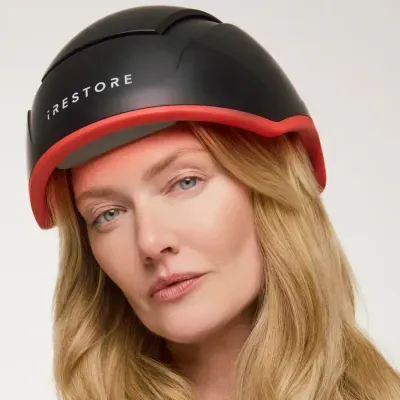
- In the largest home hair-laser trial, 269 people: dry skin 5.1%, itch 2.5%, scalp tenderness and irritation 1.3% each, some warmth, no serious events; the maker funded it (Jimenez 2014).
- Two NIH-funded trials shone red LED light on forearms at 160 to 640 J/cm². It was safe up to 320 J/cm² in people of color and 480 J/cm² in non-Hispanic white people; blisters and lasting redness appeared in one person at 480 and two at 640 (Jagdeo 2020). That safe ceiling for darker skin is about 18 mask sessions at once.
When I queried the FDA's adverse-event database on Oct 7, 2026, it held 107 reports under OHS, the product code for over-the-counter light-based wrinkle devices that covers many LED masks. Ten from 2023 to 2026 mention a burn, and some describe misuse: blisters after using a mask with tretinoin, burn marks after someone fell asleep in a mask whose shut-off failed (openFDA query). The reports aren't verified and give no rate, so I don't name brands. A 2023 case report describes a lupus-like skin reaction after an LED mask (Kotirkova 2023). I found no trial listing headache as a side effect. Why more light isn't better is on how to use red light therapy.
Does red light tan you? And what are gym "red light beds"?
Red light doesn't tan you. In volunteers with skin types III and IV, 415 nm blue-violet light darkened skin for up to three months, while 630 nm red "did not induce hyperpigmentation" (Duteil 2014). Darker skin is the exception: broad visible light (400 to 700 nm) caused darker, longer-lasting pigment than UVA1 in 20 people with skin types IV to VI (Mahmoud 2010). That's why the AAD says, "If you have a darker skin tone, talk with a dermatologist before using an at-home red-light device."
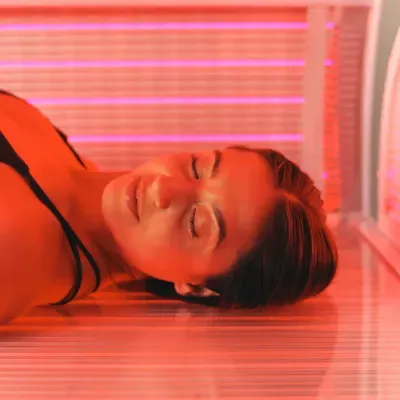
Federal tanning rules don't cover red light: under 21 CFR 1040.20, a sunlamp product uses ultraviolet lamps at 200 to 400 nm "to induce skin tanning." Gym "red light beds" are something else. Planet Fitness's Australian site describes its Total Body Enhancement booth as "UV-free red light technology" plus a vibration plate (Planet Fitness Australia); I couldn't open the U.S. page or find the wavelength. A salon bed that also has UV lamps meets the sunlamp definition, UV risks included.
Medications, epilepsy and light sensitivity
The FDA describes drug photosensitivity as a reaction to ultraviolet light and lists culprits such as doxycycline, isotretinoin, ibuprofen and hydrochlorothiazide (FDA). I found no study showing these react to red LEDs. Some prescription drugs, though, are made to react to red light: in photodynamic therapy, aminolevulinic acid is activated with a 635 nm red lamp (Goldenberg 2025). If you've been prescribed a photosensitizer, a home device is a question for the doctor who prescribed it.
Epilepsy is about flashing light: flicker at 15 to 25 Hz is the most provocative, red color is a factor, and about 1 in 10,000 people has a seizure from light (Fisher 2005). The paper isn't about LED therapy, so it matters for devices with pulsed modes. Some makers rule it out outright: Solawave's wand manual says "DO NOT use the device if you have a medical history of seizures or epilepsy triggered by light" (Solawave manual).
Who should check with a doctor first
There's no official list. Mito says so itself: "There are no industry-wide accepted contraindications for red light therapy." Here's what four makers' documents say.
| Condition | Omnilux | CurrentBody | Joovv | Mito |
|---|---|---|---|---|
| Pregnant or breastfeeding | Don't use | Ask a doctor | Don't use | Ask first |
| Cancer or suspicious lesions | — | Ask a doctor | Ask a doctor | Theoretical risk; ask first |
| Light-sensitizing medicines | Don't use | Ask a doctor | Ask a doctor | Relative contraindication |
| Light sensitivity, lupus | Don't use | Ask a doctor | Don't use if photosensitive | Avoid; lupus relative |
| Eye disease | Don't use (genetic) | Ask a doctor (genetic) | Not while healing from LASIK | Hazard; not after LASIK |
| Steroids | — | — | Don't use | Not together |
| Overactive thyroid | — | — | Precaution | Hazard on neck and chest |
| Tattoos | — | — | Black ink may blister | Ink may fade |
| Recent burns | — | — | — | Don't use |
Omnilux also lists light-triggered headaches. If a row applies to you, take the manual of the device you're considering to your doctor.
A safer-use checklist
- Use the eye protection your manual calls for, not sunglasses. With a mask, keep your eyes closed, especially with blue light.
- Stick to the label time. Light shows a "biphasic" dose response, where low doses often beat high ones (Huang 2009); Mito says "DO NOT exceed 20 minutes" per session. Schedules are on how to use red light therapy.
- Do the skin test if your brand asks. CurrentBody's: a 10-minute session on your arm; redness lasting "more than 2 hours" means sensitivity to light.
- Don't fall asleep under a device. Mito: "DO NOT let sleeping, disabled, or unconscious persons use the device."
- Keep it off a known tumor, a changing mole and, in pregnancy, the belly.
- New prescription or retinoid? Reread the label before the next session.
Masks with a 510(k) you can check: FDA-cleared LED face masks. Other devices: best red light therapy devices. What the light does: red light therapy benefits.
Questions people ask
Is there any danger in red light therapy?
The documented risks are to the eyes, mostly with blue light and uncovered eyes, plus mild, short-lived redness or dryness. Burn reports to the FDA are few, and some followed misuse.
Why can't cancer patients use red light therapy?
Makers ask them to see a doctor first because lab and mouse studies are mixed, and very high doses sped up melanoma in mice. Cancer guidelines use a laser inside the mouth by clinical protocol, not a home panel.
Can red light therapy age your skin?
I found no study showing that. Red light at 630 nm didn't darken skin in a 2014 study; blue-violet light did.
Are LED face masks safe?
Side effects in trials were mild; the two published eye cases involved a blue-light mask with open eye holes and a red light mask (cause unproven). Use the eye protection in the box.
Where should you not put red light therapy?
Over open eyes, a known tumor or a suspicious spot, and the belly in pregnancy. Mito adds recent burns; Joovv adds black tattoos, which may blister.