














Sauna vs steam room: the difference in heat, humidity and evidence

A sauna is dry heat: a Finnish sauna runs at 176–212°F with 10–20% humidity. A steam room is much cooler but close to 100% humidity: the steam pods in one study ran at 111°F and 99%. Dry saunas have large long-term studies behind them; steam rooms have only small ones. At home, both usually need a 240 V line, and a steam room also needs a sealed, waterproof space.
Sauna vs steam room at a glance
| Sauna (dry) | Steam room | Infrared sauna | |
|---|---|---|---|
| Temperature | 176–212°F (80–100°C) | About 104°F (40°C) to 111°F (44°C) in studies | 110–135°F |
| Humidity | 10–20%, briefly higher when you pour water | 84–99% in studies | Dry |
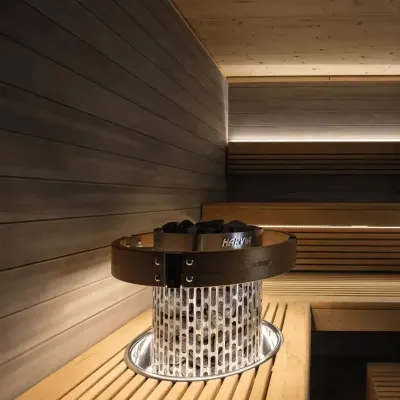
| Heat source at home | Electric or wood stove; electric heaters in our database are 6–9 kW | Steam generator, 0–5 kW in our database | Infrared panels |
| Power at home | 9 of 12 electric heaters run on 240 V | All 4 generators run on 240 V | Mostly 120 V |
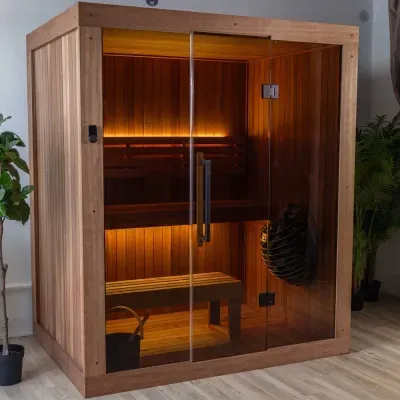
| Room | A wood-lined dry room or cabin | A sealed, waterproof shower or room; generators here are sized for up to 140–250 cu ft | A prefab cabin |
| Research | Large Finnish cohort (association) plus small trials | A few small studies | Mostly trials in heart failure patients |
Sources: Laukkanen and Kunutsor, 2024 (dry sauna); Willmott 2023 and Ünübol 2010 (steam); Cleveland Clinic (infrared). Infrared is compared in depth on infrared vs traditional sauna.
How your body responds to each
You'd expect the cooler room to be easier on you. The one direct comparison I found says the opposite. In a 2019 study of 10 young women, three 15-minute rounds in a humid sauna at 138°F (59°C) and 60% humidity raised core temperature and heart rate more than the same rounds in a dry sauna at 196°F (91°C). The dry sauna took off more weight, which was water. The authors concluded that the wet sauna "creates a greater burden."
Ten people is a small study, so treat it as a caution, not a rule. It's enough to doubt the common line that steam is the gentler choice.
What research covers each
Dry sauna. The Finnish Kuopio cohort linked using a sauna four to seven times a week with lower rates of fatal heart disease, stroke and dementia than once a week. Those are associations in one population of traditional sauna users, and the details are on sauna benefits.
Steam room. The research is thin and mostly about breathing. Steam didn't help colds in a Cochrane review or lower virus levels in a 1994 trial, and advice to inhale steam for chronic sinus symptoms didn't work in a trial of 871 adults, apart from less headache. In allergic rhinitis, symptoms fell after steam baths with or without herbs, but the trial had no group without steam. More on steam sauna benefits.
The Finnish findings come from dry saunas. They don't tell you anything about steam rooms.
Which is easier to have at home
A dry sauna is a cabin or a kit with a heater, usually on a 240 V circuit; every electric heater in our database but 1 is rated for pouring water on the stones, so you can still make steam. Options are on dry saunas and sauna kits.
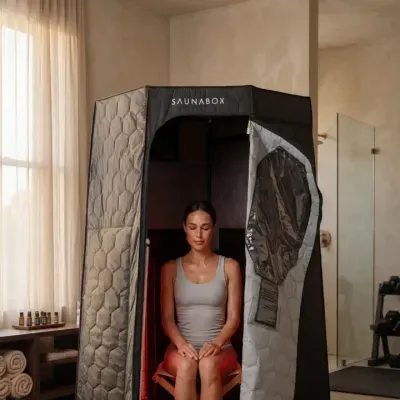
A steam room needs a steam generator plumbed into a fully enclosed shower or room, which means an electrician for the 240 V line and usually a plumber for the water and drain; follow the generator's installation manual for the enclosure. The cheaper route is a portable steam tent with a small steamer: portable steam saunas. Generators and home steam showers are on steam saunas.
Same safety rules for both
- No alcohol. About half of sauna deaths in Finland involved alcohol (2008 study).
- Don't go alone. Of 77 sauna deaths in Sweden, all but 2 people were found alone (2008 study).
- Drink water. Three 20-minute sauna sessions took off up to 1.8% of body weight in water in a small study.
- Check with a doctor first if you have unstable heart disease, are pregnant or take blood pressure medicines (review, 2001; review, 2006).
The full list is on sauna safety; this page isn't medical advice (medical disclaimer).
Questions people ask
Is a sauna or a steam room better for you?
No study compares their health effects head to head. Dry saunas have far more research, mostly observational, and the one small comparison found humid heat harder on the body than much hotter dry heat. Choose by what you enjoy and what you can install.
What is the difference between a steam sauna and an infrared sauna?
A steam room heats humid air to around 104–111°F; an infrared sauna heats your body with panels in dry air at 110–135°F. More on infrared vs traditional sauna.
What do 10 minutes in a steam room do?
Your core temperature and heart rate go up, and you sweat. In one study, men in steam pods at 111°F reached a core temperature of about 100.6°F over 60 minutes. What steam has and hasn't been shown to do is on steam sauna benefits.
What is 30 minutes in the sauna equivalent to?
It isn't equivalent to a workout. Heart rate rises, by about 18 beats a minute across pooled studies, but in a small trial, 45 minutes in an infrared sauna didn't reproduce cycling's effects on blood pressure or arteries (Hussain 2022).
What toxins does a sauna remove?
Researchers have found small amounts of toxic elements in sweat, but no study shows that sweating them out improves health (Sears 2012). Cleveland Clinic calls that research "still in its infancy."