









PlatinumLED BioMax review: the 300, 900 and Pro Ultra by the numbers
4 devices: 3 panels and 1 red light sauna, $659 to $1,599. If output is what you're paying for, the BioMax line tops our panel database: Alex Fergus measured 101 mW/cm² on average from the Pro Ultra and 90 from the 900. Unusually, PlatinumLED's own test report for the Pro Ultra (102.62 average) lands close to that, while the figures Hooga and Mito publish for their big panels are 1.6 to 2.0 times the peak he measured. Every BioMax has a 3-year warranty and 60 days to send it back, but an elective return costs a 20% restocking fee plus the shipping.
Skip it if you want an FDA clearance: the BioMax is registered and listed, not cleared. And if you only need a small area covered, the $659 BioMax 300 has no independent measurement yet.
 By Kirill Gissa · Published · Prices and FDA checked Oct 8, 2026
All 4 PlatinumLED devices
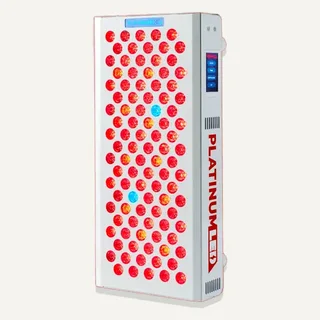
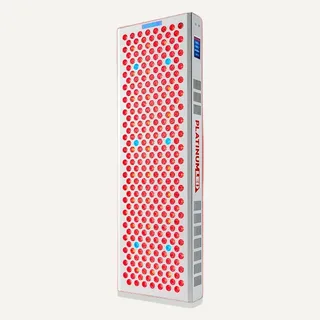
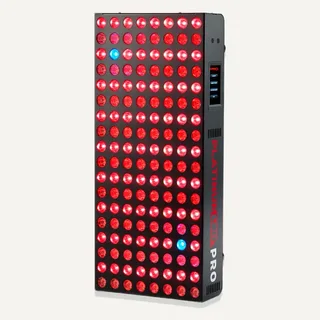
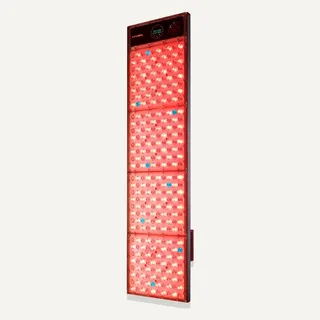
Verdict: which BioMax, and who should skip it
($1,299) for full-body sessions at the lowest price per measured milliwatt in this line.
($1,599) if you want the highest measured output and adjustable settings; it draws up to 793 W on high.
($659) is a targeted panel, 19 × 9 × 3 in; PlatinumLED's own report is the only output figure for it.
if FDA clearance matters to you, if you want a mask-style device for the face (see masks), or if you want proof from a trial that this panel does anything for a given condition. No consumer panel has that; what the studies show is a separate question from output.
BioMax 300 vs 900 vs Pro Ultra
| BioMax 300 | BioMax 900 | BioMax Pro Ultra | |
|---|---|---|---|
| Price | $659 | $1,299 | $1,599 |
| Wavelengths | 480, 630, 660, 810, 830, 850 and 1060 nm | 480, 630, 660, 810, 830, 850 and 1060 nm | 480, 630, 660, 810, 830, 850 and 1060 nm |
| LEDs | 100 (48 red, 50 NIR, 2 blue, per LightLab report) | 300 (144 red, 150 NIR, 4 blue, per LightLab report) | 432 (210 red, 216 NIR, 6 blue, per LightLab report) |
| Size and weight | 19 × 9 × 3 in; 11 lb | 36 × 12 × 3 in; 33 lb | 36 × 12 × 3 in; 29 lb |
| Brand figure | 90.41 mW/cm² at center, 71.79 average (7×7 grid, 350–1700 nm); LightLab International report LLIA002684-001, commissioned by the brand | No mW/cm² published | 121.12 mW/cm² at center, 102.62 average (High Power, 7×7 grid); LightLab International report LLIA002684-006, commissioned by the brand |
| Independent | Not measured | 90 mW/cm² average (9 points), spectrometer, 6 in; 8th generation (2024); article updated 2026-07-11 | 101 mW/cm² average (9 points) / 120 peak; distance and meter not stated in the article |
| Power draw | 157 W; 1.43 A at 110 V / 0.71 A at 220 V; auto 100–240 V | 380 W; 3.45 A at 110 V / 1.73 A at 220 V; auto 100–240 V | Low 389 W / High 793 W; 6.7 A at 110 V (High) |
| Session, brand | 10–20 min per area | 10–20 min per area | 12 min (Pro) vs 20 min (standard), per the brand |
Measured output, and what the brand's report measures
Alex Fergus, lighttherapyinsiders.com measured the 900 at 90 mW/cm² on average across nine points at 6 inches with a spectrometer, on the 8th-generation panel (article updated Jul 11, 2026). PlatinumLED's FAQ says the units now shipping are Gen 9, so treat that number as close but not current. The Pro Ultra measured 101 on average with a 120 peak (Alex Fergus, lighttherapyinsiders.com, Aug 21, 2025); the article doesn't state the distance. Fergus also found that the Pro Ultra, "although it's technically a seven-wavelength panel, in practice it behaves more like a five-wavelength device, as the blue and 1060 nm outputs are negligible."
One disclosure about the source: Fergus says he is "affiliated with a lot of these companies" and links to discount codes, PlatinumLED included. His numbers are still the only independent ones published for these panels, and they agree with the brand's own lab report, but you should know.
The brand's own numbers come from LightLab International reports it commissioned. For the 300 and the Pro Ultra, those reports give a grid of readings at 6 inches, which is comparable with independent tests. For the 900 the report is different: an integrating sphere, which captures the total light leaving the panel (in watts), not how much reaches a square centimeter of skin at a distance. It's a fair way to compare total output, but it can't be turned into a dose, and it's why there's no brand mW/cm² for the 900 in the table.
The comparison that matters: PlatinumLED's Pro Ultra report says 121.12 mW/cm² at the center and 102.62 on average; the independent test found a 120 peak and a 101 average. Hooga lists 165 for the ULTRA1500, where the same tester found a 104 peak; Mito lists 170 for the MitoPRO 1500+, where he measured a peak of 87. Every panel's numbers are on brand figures vs measurements.
"FDA Class II Registered": what it means
PlatinumLED describes the BioMax as an "official FDA Class II Registered Medical Device." That's accurate and narrow. In the FDA listing database, PLATINUM LED HOLDINGS LLC listed "BIOMAX 900" on Dec 19, 2019 under product code ILY, "lamp, infrared, therapeutic heating," with no 510(k). ILY is exempt from 510(k) review, so the FDA never evaluated the panel; it only received the listing. The FDA's own consumer page says the listing "does not denote approval, clearance, or authorization" (FDA). PlatinumLED's own footer says as much in other words: its products are "low-risk, general wellness / fitness products" under the FDA's general wellness policy.
One more detail from the same database: the BioMax names also appear in a 2022 listing by E.Shine Systems Limited, a company registered in China, together with models named RDPRO300 to RDPRO1500. Listing isn't proof of who builds what, but it suggests where the panels come from. Only 11 of the 38 panels in our database have a 510(k), all of them Celluma panels; the rest are listed like the BioMax. Which panels are cleared, and why most aren't: FDA-cleared red light devices.
Where PlatinumLED contradicts itself
A few things on PlatinumLED's own pages don't line up. The BioMax page headlines "Seven Wavelengths," while the comparison table on the same page lists "6w" for every size. The seven are 480, 630, 660, 810, 830, 850 and 1060 nm; the FAQ explains the blue 480 nm LEDs are controlled separately, which is probably why the table counts six, but the page never says so.
Pulsing is the bigger one. The BioMax FAQ says: "there is zero evidence that 'pulsed' output in an LED based therapy light has any proven benefit whatsoever." The Pro page sells "Variable 0 to 9999 hz for research grade precision," and its own FAQ calls pulsing "an add-on with no proven therapeutic benefit," added "due to customer demand." You can leave it off, which is what the brand recommends.
Eye protection gets two answers too: the product page calls the included goggles "optional and not required," while the FAQ says eye protection is "strongly recommended." With near-infrared panels this bright, go with the FAQ.
PlatinumLED vs Hooga vs Mito
| Panel | Price | Measured average | Price per mW/cm² | Warranty | Return window |
|---|---|---|---|---|---|
| PlatinumLED BIOMAX 900 | $1,299 | 90 mW/cm² | $14.43 | 3 years | 60 days |
| PlatinumLED BIOMAX PRO ULTRA | $1,599 | 101 mW/cm² | $15.83 | 3 years | 60 days |
| Hooga ULTRA1500 | $1,399 | 81.7 mW/cm² | $17.12 | 3 years | 60 days |
| Mito Red Light MitoPRO 1500+ | $1,169 | 76.5 mW/cm² | $15.28 | 3 years | 60 days |
On these numbers the 900 is the cheapest per measured milliwatt of the four, and the Pro Ultra costs a little more per milliwatt for the highest reading. Warranties are a wash at 3 years. Hooga's strength is lower prices across the range, including small panels: see the Hooga review. All panels ranked: best red light therapy panels.
SaunaMAX Pro
PlatinumLED also sells the SaunaMAX Pro ($959), a panel rated to sit inside a sauna; Alex Fergus, Light Therapy Insiders measured 41.1 mW/cm² on average across it. It's compared with full red light saunas on red light saunas.
What owners say
All BioMax reviews I could find are on PlatinumLED's own site: the 300 and 900 share one pool, 4.91 out of 5 from 2,920 ratings on platinumtherapylights.com, the brand's own site, and the Pro Ultra has 4.85 out of 5 from 100 ratings on platinumtherapylights.com. With no marketplace reviews to compare, the useful part is what the critical ones say:
- Across PlatinumLED's BioMax reviews on platinumtherapylights.com (4.91 from 2,920, shared by the whole line), even critics praise the panels: in at least 4 low-rated reviews that complain about stands or service, the owner says the light itself is well made or works as described. (platinumtherapylights.com)
- Among the low-rated BioMax reviews, service and returns come up most: at least 4 criticize customer service or order handling, including slow replies and missing or back-ordered stands and remotes, and 3 object to the return terms, citing a 20% restocking fee or a refused return. (platinumtherapylights.com)
- Stands and mounts draw separate criticism: 3 BioMax reviews call a stand or desk arm wobbly, flimsy or hard to adjust. (platinumtherapylights.com)
- On platinumtherapylights.com (4.85 from 100), at least 3 reviews praise the panel's quality or performance, including owners who criticize the accessories or support. (platinumtherapylights.com)
- Accessories are the main complaint: at least 3 reviews criticize a stand or the goggles, including a floor stand that blocks 30 LEDs and a stand that needs a power drill to assemble. (platinumtherapylights.com)
"Be aware of their refund policy. They charge a 20% restocking fee for any shipping issue, which is what happened to me." 1-star review, Dec 2023, platinumtherapylights.com
Questions people ask
Is PlatinumLED approved by the FDA?
No. The FDA doesn't approve red light panels; at most it clears them through a 510(k), and in our database only Celluma panels have one. The BioMax panels are registered and listed with the FDA as Class II devices under code ILY, with no 510(k) clearance. ILY is exempt from 510(k) review.
How far should you stand from a BioMax?
PlatinumLED's product page suggests "around 8"-14" for deep tissue or 16"-24" for superficial facial skin," 10 to 20 minutes per area, 3 to 5 times a week; an older FAQ says 6 to 12 inches for 10 to 15 minutes. The output figures on this page were measured at 6 inches, apart from the independent Pro Ultra reading, whose distance isn't stated, so you'll get less than that at 8 to 24.
Who should not use red light therapy?
PlatinumLED publishes no full list of contraindications. Its FAQ asks people with a pacemaker or other electronic implant to check with a physician first, and to wear the goggles if they have light sensitivity or eye conditions. Other makers' manuals add pregnancy and light-sensitizing medicines; see safety and who should skip it and our medical disclaimer.
FDA status by model
FDA 510(k) and registration databases, checked Oct 8, 2026