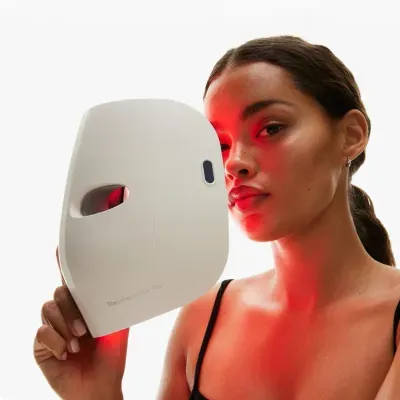


Qure LED mask review: what the FDA file shows that the website doesn't
One mask, $399. The Q-Rejuvalight Pro is cleared by the FDA for both wrinkles and mild-to-moderate acne, with some of the shortest sessions in our database (3 min) and five wavelengths, from 415 to 880 nm. Qure's website lists those wavelengths but not the output or which LEDs run in which mode; for that you need the FDA summary, which also contradicts the site on one point. Warranty is 1 year, shorter than Omnilux or CurrentBody.
 By Kirill Gissa · Published · Prices and FDA checked Oct 8, 2026
Qure Skincare Q-Rejuvalight Pro Facewear at a glance
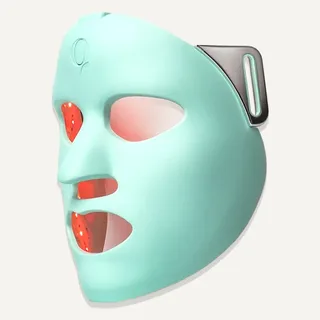
Output: "claimed" is Qure Skincare's figure with no distance stated.
Similar models with a store link
There's no store link for any Qure Skincare model. The closest ones that have one, matched on type, size and price:
Verdict
red and blue light in one mask cleared for both wrinkles and acne, and sessions of 3 min, among the shortest in our database.
you want a longer warranty (Omnilux and CurrentBody give 2 years) or an easy return: Qure's terms are 30 days, approved by Qure support; shipping non-refundable; $10 restocking fee. On its own site the mask averages 4.8 out of 5 from 251 ratings on qureskincare.com, the brand's own site; I found no marketplace reviews to compare.
Alternatives worth considering
Three cleared masks that cover the same ground or publish more (the full ranking is on best red light therapy masks):
- CurrentBody LED Red Light Therapy Face Mask: Series 3, $569.99: 415, 532, 590, 633, 830 and 1072 nm, 2 years warranty, app-controlled. CurrentBody review.
- Shark CryoGlow LED Face Mask (FW312), $299.99: 415, 630 and 830 nm, cleared for wrinkles and acne like the Qure, 128 mW/cm² in its FDA summary, 4-8 min (Better Aging 6, Skin Clearing 8, Skin Sustain 4) sessions. Shark CryoGlow review.
- Omnilux Contour Face, $395: 633 and 830 nm, no blue, 2 years device, 1 year controller.
What the 510(k) adds to the website
Qure's product page lists the five wavelengths and a 3-minute treatment, and stops there. The 510(k) summary for K230042 adds the rest:
| Spec | FDA summary |
|---|---|
| Wrinkle mode | 605, 630, 660 and 880 nm; 70 mW/cm² total |
| Acne mode | 415 and 630 nm; 45 mW/cm² total |
| Output by wavelength | 605 nm 15, 630 nm 20, 660 nm 25, 880 nm 10, 415 nm 25 mW/cm² (each ±5) |
| LEDs | 80 dual-chip: 30 × 630+415, 25 × 630+605, 25 × 660+880 |
| Session | 3 min per mode, then it switches off |
| Cleared for | "treatment of wrinkles and mild to moderate inflammatory acne" (codes OHS and OLP) |
The contradiction: Qure's page puts blue 415 nm in its Skin Rejuvenating (wrinkle) treatment as well, while the FDA file describes the wrinkle mode as "605nm, 630nm, 660nm, and 880nm" and keeps 415 nm for acne. The page also says "160 dual core" LEDs where the FDA counts 80 dual-chip ones. At 70 mW/cm², the figure in the FDA summary is the third-highest stated output among the masks we track, behind Shark and Therabody; nobody independent has measured it.
Who actually filed it
The 510(k) names three companies. The applicant is Light Tree Ventures Europe B.V, based in the Netherlands, for model P19-0023. The manufacturer is Shenzhen Kaiyan Medical Equipment in China, which also filed the clearance for the CurrentBody LED Red Light Therapy Face Mask: Series 2 (K250966). Qure Skincare, of Sydney, appears as the distributor. In the FDA listing database the mask name sits under 3 registrants: LIGHT TREE VENTURES EUROPE B.V., SHENZHEN LIGHT TREE VENTURES MEDICAL TECHNOLOGY CO.LTD and Shenzhen Kaiyan Medical Equipment Co., Ltd.
Light Tree Ventures also filed the clearances for the Bon Charge Red Light Cap (K253349) and the CurrentBody LED Hair Growth Helmet (CurrentBody Skin LED Hair Regrowth, MZ-07) (K230336). That's normal contract manufacturing, and a reason to compare specs rather than logos. How the factories behind cleared masks line up: FDA-cleared LED masks.
Qure vs Omnilux
| Qure Q-Rejuvalight Pro | Omnilux Contour Face | |
|---|---|---|
| Wavelengths | 415, 605, 630, 660 and 880 nm | 633 and 830 nm |
| Cleared for | Wrinkles and acne | Full-face wrinkles |
| Stated output | 70 mW/cm² (wrinkle mode) | about 30 mW/cm² |
| Session | 3 min | 10 min |
| FDA 510(k) | K230042, Apr 28, 2023 | K191629, Sep 12, 2019 |
| Warranty | 12 months (paid 1-year extension for $39) | 2 years device, 1 year controller |
| Returns | 30 days, approved by Qure support; shipping non-refundable; $10 restocking fee | 30 days for LED devices |
| Price | $399 | $395 |
Omnilux is the simpler choice for wrinkles alone; Qure adds acne coverage and much shorter sessions. More in the Omnilux review.
"My skin got worse": what Qure says to do
Qure's own mask guide asks for a test before the first session: a full 3-minute treatment on the inner forearm, then wait 24 hours. "If you experience pain, discomfort, or redness lasting more than 2 hours, you might be light-sensitive. Please consult a doctor for advice before continuing use." Its FAQ adds that skin types V and VI on the Fitzpatrick scale "may be more sensitive to visible light," with "a small risk of pigmentation changes," and recommends closing your eyes and wearing eye protection.
If your skin gets worse after you start, stop and see a dermatologist rather than pushing through. What mask light can and can't do, by the studies: red light therapy benefits.
About the 87%
Qure's page says "87% of users reported smoother facial wrinkles and fine lines," and that 83% noticed fewer breakouts. Its own footnote says these come from customers' "self-perception surveys and before-and-after images." That's satisfaction, not measurement. Controlled trials of masks show smaller and slower changes: what trials measured, week by week.
Questions people ask
Is Omnilux better than Qure?
For wrinkles alone, Omnilux gives a longer warranty and a simpler two-wavelength design. Qure is also cleared for acne and runs 3 min sessions. Both are FDA-cleared; the table above has the details.
How often should you use the Qure mask?
Qure's guide says "at least 3–5 times per week" and that daily use is safe, one treatment per day; its product page leans toward daily. The one mask trial that compared schedules found two sessions a week did as well as three (Bragato 2025, randomized, sham).
Do LED light masks really work?
Trials show small, slow changes in wrinkles over 8 to 12 weeks, and better evidence for blue-plus-red light in acne. Details: what the research supports and before and after.
Is the Qure mask FDA cleared?
Yes: 510(k) K230042, decided Apr 28, 2023, for wrinkles and mild to moderate inflammatory acne. "Cleared" means the FDA found it equivalent to masks already on the market; no LED mask goes through the separate "approval" process for higher-risk devices.
FDA status by model
FDA 510(k) and registration databases, checked Oct 8, 2026