Red light therapy dosage calculator: how many joules your device delivers

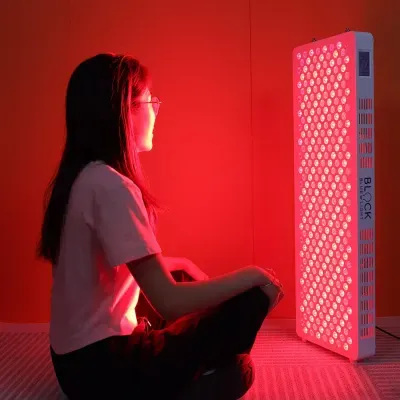
Dose in joules per square centimeter is irradiance times time: J/cm² = mW/cm² × seconds ÷ 1,000. Ten minutes under the Hooga ULTRA1500 is 99 J/cm² on the brand's figure of 165 mW/cm² at 6 inches, or 49 J/cm² on an independent reading of 81.7 mW/cm² at the same distance. Nobody has pinned down the best dose: the skin and hair studies and FDA summaries below range from about 1 to 18 J/cm² per session.
How the dose is calculated
Irradiance is how much light power lands on each square centimeter of skin, in milliwatts. Multiply it by the session length in seconds and divide by 1,000, and you get the energy delivered, in joules per square centimeter. That's the number studies report as "fluence" or "dose".
The same ten minutes means very different things on different devices. I ran the brand figures from our database through the formula:
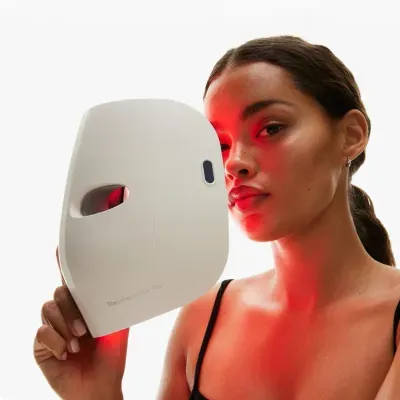
- Omnilux Contour Face: 30 mW/cm² for 10 minutes is 18 J/cm².
- Shark CryoGlow LED Face Mask (FW312): 128 mW/cm² for its 6-minute Better Aging mode is 46 J/cm², more than double the Omnilux in less time.
- Celluma HOME (Series 2): 6.5 mW/cm² for 30 minutes is 12 J/cm².
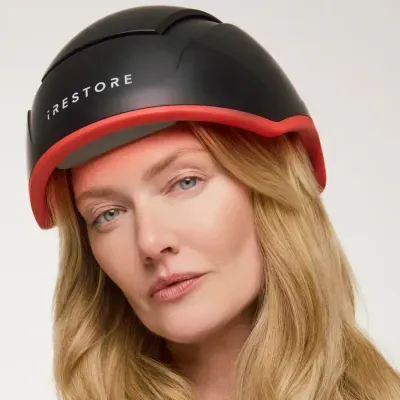
- CurrentBody LED Hair Growth Helmet (CurrentBody Skin LED Hair Regrowth, MZ-07): 1.67 mW/cm² for 10 minutes is 1.0 J/cm², which matches the 1 J/cm² in its FDA summary.
So "use it for 10 minutes" only makes sense for the device it was written for. Swap the device and the dose changes, sometimes tenfold.
Brand numbers vs meter readings
The calculator is only as good as the irradiance you put in, and brand figures run high. For 9 panels in our database there's both a brand figure and a published independent reading. Every reading came in below the brand's number: between 41% and 83% of it, with a median of 52%. All of those readings are by Alex Fergus at lighttherapyinsiders.com.
Two more problems show up when you line the specs up. 19 devices give only a lower bound, such as "more than 100 mW/cm²", so the dose you calculate is a floor at best. And 50 devices have a brand figure with no distance and no independent reading. Irradiance from a panel drops as you step back, so a number without a distance can't tell you the dose at the 12 or 18 inches the manual asks for.
My rule of thumb: if there's an independent reading at a stated distance, use that, and stand at that distance. The calculator picks the meter reading by default for the 11 devices that have one. The panel irradiance page shows every brand-vs-meter pair side by side.
What doses studies used
Studies on skin and hair used a wide spread of doses, and none of them compared enough doses to name a best one. Harvard Health put it plainly in 2025: scientists "haven't yet pinned down how long each treatment session should last" (Harvard Health).
| Study or document | Light | Irradiance | Time | Dose | How often |
|---|---|---|---|---|---|
| Mota 2023, split-face randomized trial, 137 women (PubMed) | 660 nm red vs 590 nm amber | not in abstract | 10 min | 3.8 J/cm² | 10 sessions in 4 weeks |
| Bragato 2025, randomized, sham-controlled, 95 women (PubMed) | 660 nm mask | 6.4 mW/cm² | 21 min | 8.05 J/cm² | 2 or 3 a week, 4 weeks |
| Wunsch & Matuschka 2014, controlled trial, 136 people (PubMed) | 611–650 nm or 570–850 nm full-body units | not in abstract | — | about 9 J/cm² | 2 a week, 30 sessions |
| Couturaud 2023, single group, brand-authored (PubMed) | 630 nm mask | 21.7 mW/cm² | 12 min | 15.6 J/cm² | 2 a week, 12 weeks |
| Kim 2026, single group, 20 people (PubMed) | 600–900 nm device | 0.81 mW/cm² | 30 min | 1.5 J/cm² (87 J/cm² over 12 weeks) | 5 a week |
| Omnilux Contour, FDA 510(k) K191629 | 633 + 830 nm mask | 30 mW/cm² | 10 min | 18 J/cm² (my calculation) | per the brand, 3 to 5 a week |
| CurrentBody hair helmet, FDA 510(k) K230336 | red LED helmet | 1.67 mW/cm² | 10 min | 1 J/cm² | daily |
A few things worth knowing about that table. Bragato 2025 compared two and three sessions a week and found no difference on its blinded wrinkle scale; patients were satisfied with both. Mota 2023 had no untreated group, only red against amber. Couturaud 2023 was written by the brand that made the mask. Separately, safety trials on healthy forearm skin found red LED light safe up to 320 J/cm² for skin of color and 480 J/cm² for non-Hispanic white participants (Jagdeo 2020). That's a safety ceiling, not a target.
More is not better
Light therapy follows what researchers call a biphasic dose response: past a point, more light does less, not more. A 2009 review describes low doses often working better than high ones (Huang 2009), and a 2011 follow-up found the same pattern when either the dose per session or the number of sessions went up (Huang 2011).
Brands say the same in their manuals. Mito's guide for the MitoPRO says "More is not always better" and caps a session at 15 minutes per area (Mito manual). Joovv's treatment guidelines say that beyond its standard sessions "the evidence points to diminishing returns" (Joovv support).
Follow the manual, not the calculator
Use the calculator to compare devices and to see what a session actually delivers. For how long, how close and how often, the device's own manual wins: it was written for that LED layout and its timer. Masks and caps often stop on their own after a set time for that reason.
For distances and session plans by device type, see how to use red light therapy. Who should check with a doctor first, and what to do about your eyes, is on is red light therapy safe. What the studies show it does, and doesn't do, is on red light therapy benefits.
Questions people ask
How many joules of red light do I need?
No one knows the best number. The studies and FDA summaries in the table above range from about 1 to 18 J/cm² per session, two to five times a week or daily. Start from your device's manual.
How do I calculate red light therapy dose?
Multiply irradiance in mW/cm² by the session time in seconds, then divide by 1,000. 30 mW/cm² for 10 minutes (600 seconds) is 18 J/cm².
Is 10 minutes of red light enough?
It depends on the device. Ten minutes is 3.9 J/cm² on a 6.5 mW/cm² pad and 99 J/cm² on a panel rated at 165 mW/cm².
Can you overdo red light therapy?
Reviews describe a biphasic response, where too much light does less good. Brands cap sessions for the same reason. Stick to the manual's time and distance.